B2B SaaS for construction professionals
Zonance
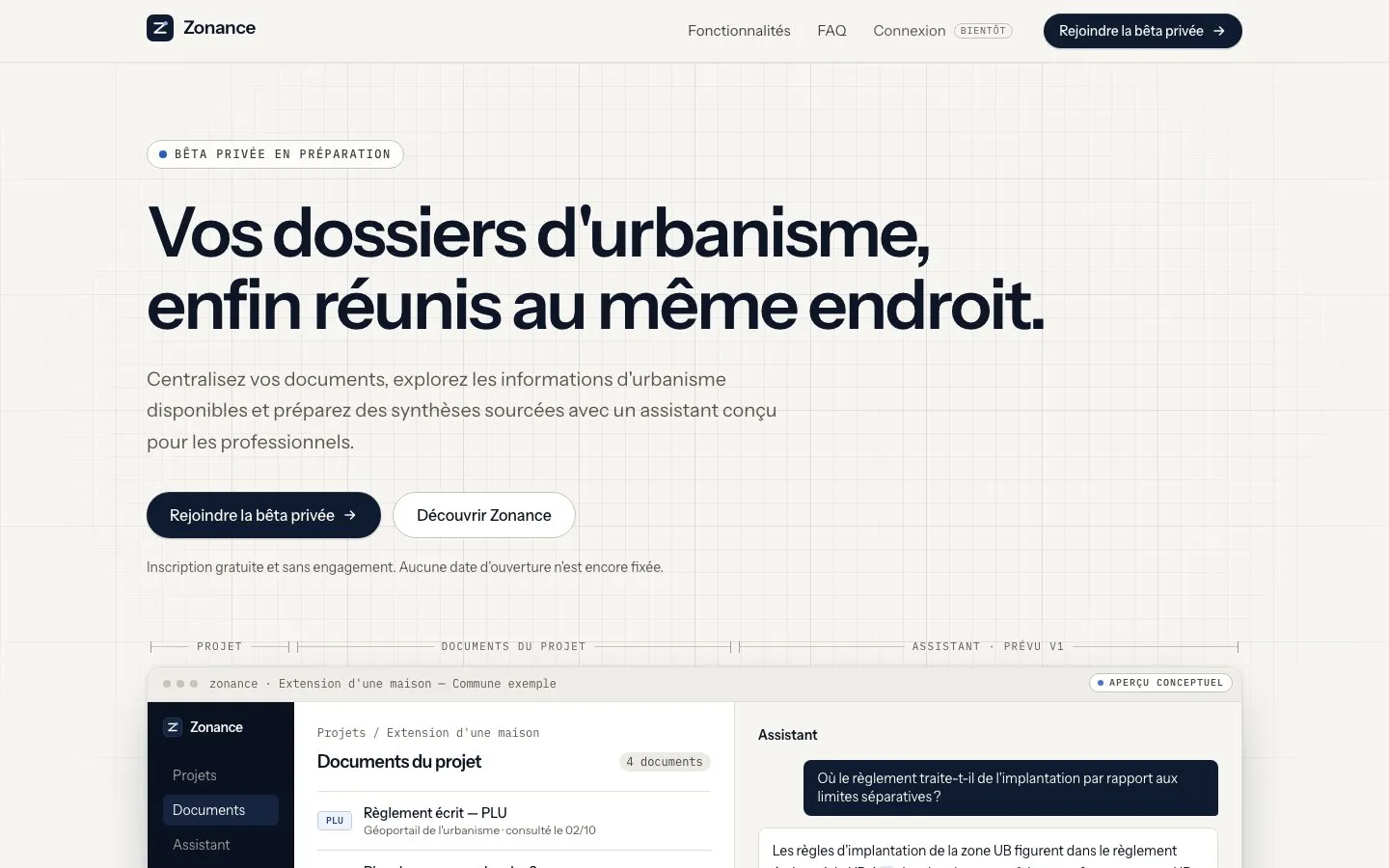
A SaaS that helps architects and building designers prepare planning applications: land parcel, local zoning rules, application documents and an AI assistant that cites its sources.
- Next.js
- TypeScript
- Supabase
- PostgreSQL
- PostGIS
- Node.js workers
- LLM
- Playwright
Context
Goals
- Bring a parcel's information together: address, land registry, planning rules.
- Structure the preparation of the application and the tracking of required documents.
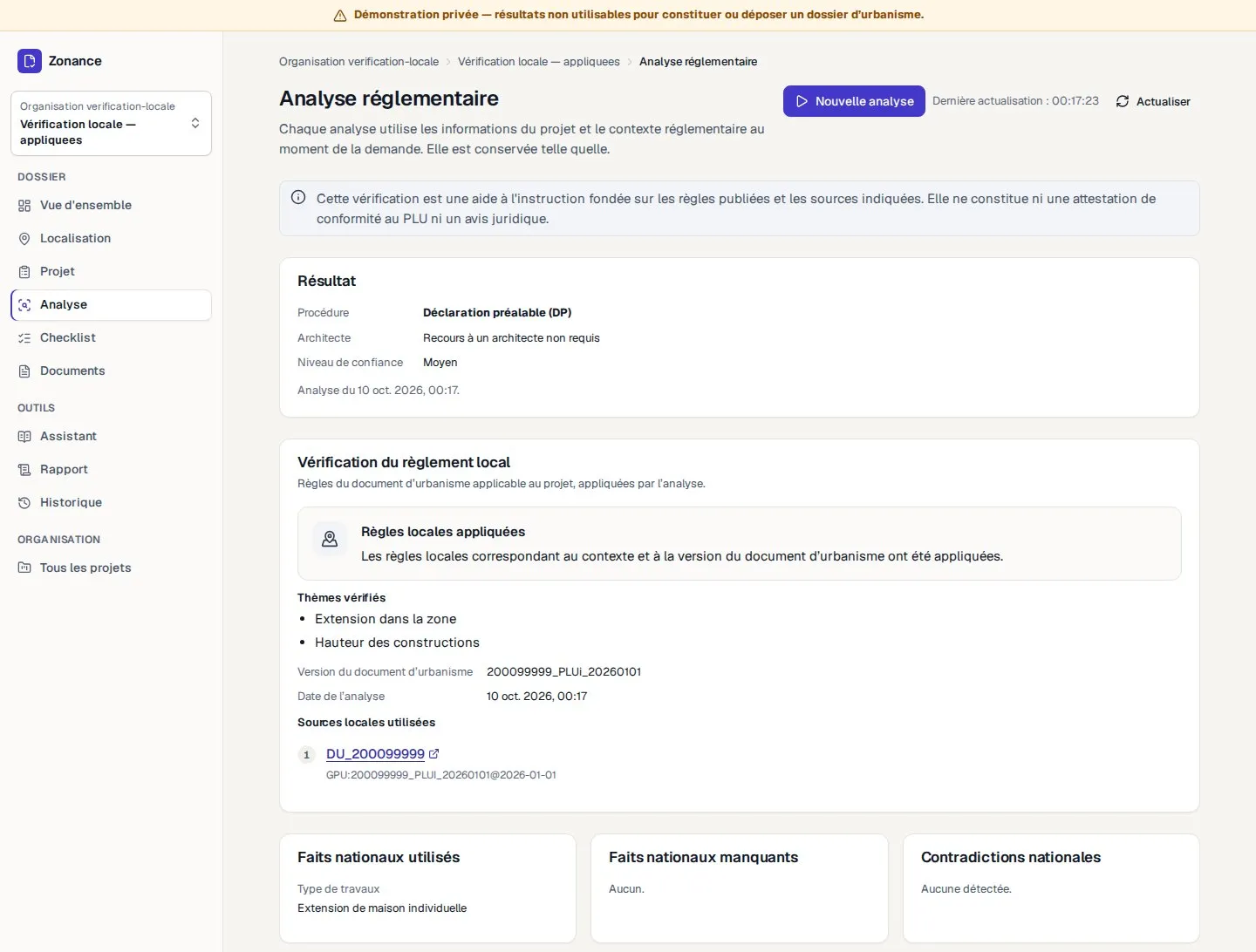
- Trace the source of every piece of information, without ever standing in for legal advice.
- Strictly protect each firm's documents and data.
The need
For a planning application, the applicable rules are spread across the local zoning plan, the land registry and national texts. Cross-checking them takes time on every project, and an incomplete file leads to requests for documents and delays.
A support tool therefore has to handle complex public data, confidential documents and AI, while staying cautious: it prepares and checks, it does not decide.
The solution
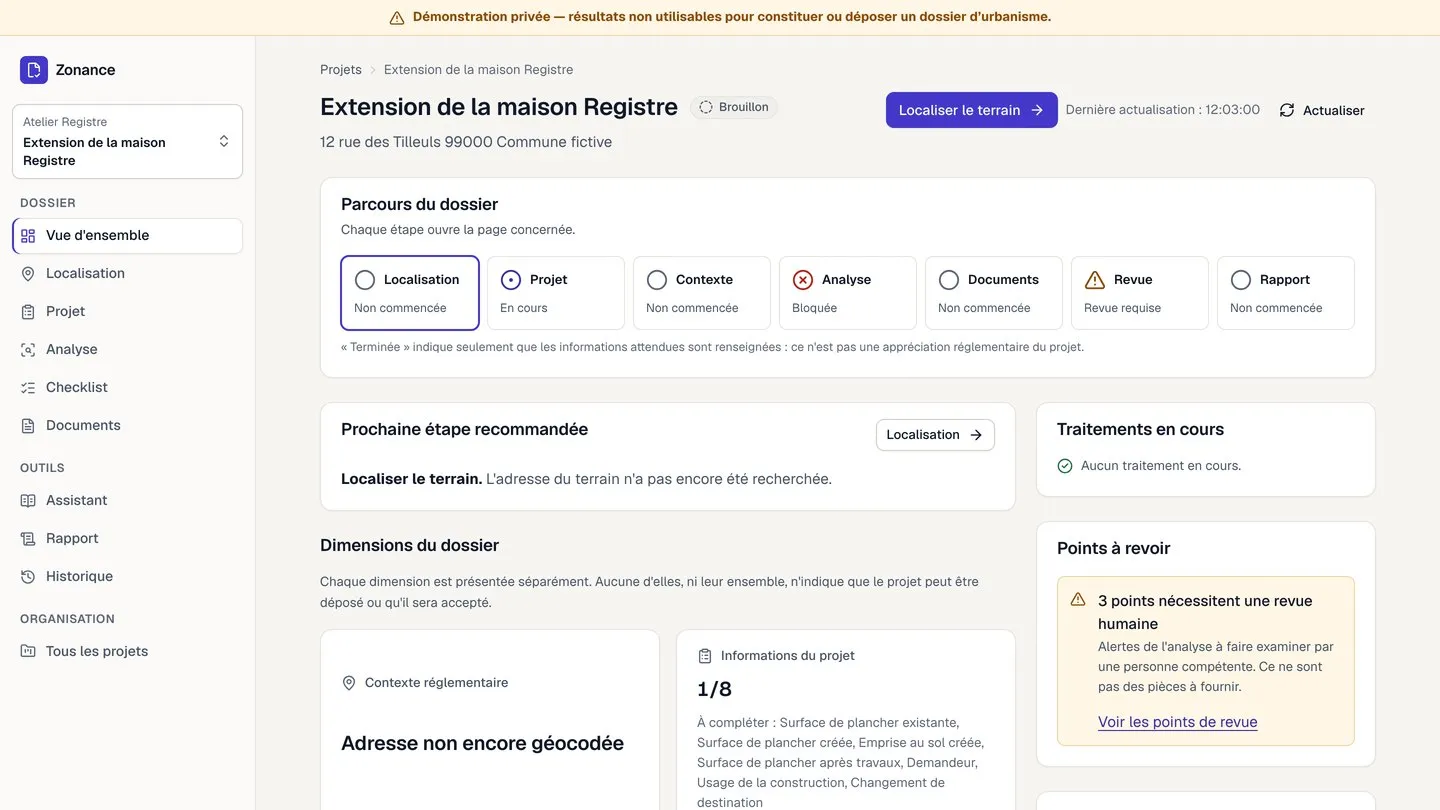
Zonance starts from the project address. The app identifies the parcel, retrieves the zoning from public planning sources, guides the project description and tracks the application documents. A versioned, printable report sums it all up.
An AI assistant, in demo, answers questions with cited sources and always reminds users that human review is required. The product is currently in private demo; the public website presents the offer and collects beta sign-ups.
Key features
- 01
Guided project workspace
A step-by-step journey per application: location, project, context, analysis, documents, review and report, with a completeness overview.
- 02
Automatic location
Address lookup in the French national address database, parcel identification confirmed by the user, zoning retrieved from the national planning portal.
- 03
Secure document handling
Upload, quarantine, antivirus scan and text recognition (OCR) in network-isolated containers, before storage.
- 04
Sourced AI assistant
Answers grounded in cited regulatory sources, compatible with several AI providers, with quotas and a spending cap. In the demo, providers are simulated: no data is sent to an external service.
- 05
Organisations and roles
Invitations, roles, two-factor authentication and an expert review area. Each organisation only sees its own files.
- 06
GDPR by design
Retention periods, purge, pseudonymisation and account erasure. On the public site: a waiting list with third-party-free anti-spam and consent-based analytics.
Architecture and technical choices
- Next.js, strict TypeScript and a documented API
- App and versioned REST API in the same project, data validated with Zod.
- Data isolation inside PostgreSQL
- Supabase with Row Level Security on business data: isolation between organisations is enforced by the database itself and tested (pgTAP). PostGIS for geography and pgvector for text search.
- Long-running work outside the app
- A separate Node.js worker with a job queue handles planning-document imports (GDAL), OCR, antivirus scans and report generation.
- Quality and operations
- Unit, integration, database and Playwright E2E tests; GitHub Actions CI with a merge gate; documented architecture decisions (ADRs); self-hosted pre-production with encrypted backups.
My role
Personal project, run solo: product, architecture, development, infrastructure and public website.
- Product framing, user journeys and regulatory scope.
- Architecture: multi-organisation, app / worker split, data and security policy.
- Specifications, code review and acceptance testing of every change.
- Pre-production infrastructure, CI and backups.
- GDPR-compliant public website and waiting list.
AI assistance · Development done with the help of Claude Code, under my technical direction: product design, specifications, architecture, review and sign-off of every change, framed by documentation, tests and a blocking continuous integration.
Outcomes
- An application that works end to end in private demo, from address lookup to report; planning rules still need validating before any opening.
- An architecture ready for sensitive data: per-organisation isolation, quarantined documents, documented GDPR measures.
- A live public website with a waiting list; a Lighthouse accessibility score of 100 during acceptance testing.
Gallery
Have a similar project?
Tell me about your need in a few lines. We'll work out together what is feasible, in what order and on what budget.